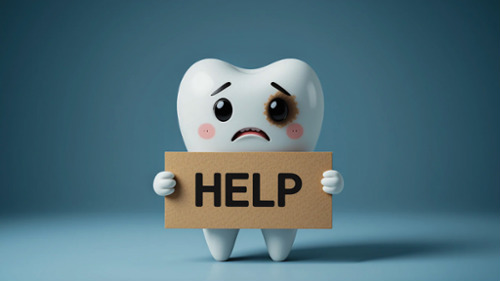
There's something I run into almost every day at the office that I rarely hear anyone say out loud: parents feel guilty bringing their kids to the dentist.
It's a strange thing to write about. But I see it constantly, and I'd rather name it than let it sit there quietly making people feel bad. So if you're one of those parents, the one bracing yourself in the waiting room, or the one who walked in happy and left feeling like you got the wind knocked out of you, this one's for you.
First, the thing I most want you to hear: you're not alone. More than half of kids have a cavity by the time they reach kindergarten. That doesn't make cavities good, and it doesn't make them something we shrug off. It just makes them normal, and common, and not a verdict on you.
The guilt tends to come from a few places. Let me take them one at a time.
"My kid is going to have a miserable experience."
This one I understand completely. Your child gets diagnosed with cavities, and your mind immediately jumps to what they'll have to sit through to fix them. But minimizing that experience is the entire point of how we practice. My real hope is that a kid who comes to us ends up walking into a dentist's office on their own in college, not because a parent made them, but because nothing about it ever scared them.
That's not always easy, especially with a young child who has a mouth full of cavities. But there is always a plan. We can be creative, we can talk through options, and we can customize it for your specific kid. We will land on something that gets the work done without traumatizing your child. There's always a way.
"Other parents are going to judge me."
I see this one most when we start talking about stainless steel crowns, the silver caps that cover a badly decayed baby tooth. Same with silver diamine fluoride, a minimally invasive option we use a fair amount. The minimally invasive part is great. The less great part is that it stains decay black. So yes, there are kids in our neighborhood walking around with a dark spot on a tooth or two.
Here's what I'll tell you from the other side of the chair: it doesn't make your kid unusual. Walk into just about any elementary classroom and look around, and more than one kid in that room has a silver cap back there. The judgment we brace for usually never shows up in real life. And if someone really is going to judge you over your child's teeth, that's probably not a person whose opinion you need anyway.
"I don't want to pass my own dental anxiety to my kid."
Dental anxiety isn't inherited, but kids are remarkable at picking up the cues, the tone, the flinch, the word choice. I don't want your child to have a bad experience that turns into adult anxiety. I also don't want your anxiety quietly transferring over to them. A lot of the planning we do is aimed at exactly that: getting your kid through treatment calmly and keeping the worry from jumping from one generation to the next.
"If my kid has cavities, I failed as a parent."
This is my favorite one to push back on because it could not be more wrong.
You can be an outstanding parent and have a child with a whole bunch of cavities. The reverse is also true: you can be a pretty checked-out parent and have a kid with perfect teeth. Cavities are multifactorial. Some of what drives them is inherited. And the effort it takes to keep one child cavity-free can be wildly different from what it takes for another.
We all know this from our own lives. Everybody knows someone who never flosses, rarely brushes, avoids the dentist for years, finally goes in, and gets a clean bill of health. Good for them, but it doesn't make their habits right. They're just getting away with it. And we all know the opposite person too: careful about brushing and flossing, easy on the sugar, drinks their water, does everything right, and still turns up every six months with a little something here and a little something there.
So carrying the weight of "my kid's cavities are my fault" isn't fair to you, and it isn't useful. It doesn't move anything forward.
What actually moves things forward is looking ahead. Taking care of the cavities in front of us in a way that's gentle on your child, and then building better habits slowly, not overnight, just small changes stacked over a long stretch of time until you end up where you wanted to be.
So if you're reading this already feeling guilty, or you're bracing for a visit where the news might not be great, this is my best attempt to take some of that off your shoulders. Come in, ask your questions, and make sure the plan is one you're actually comfortable with. Then we'll head in the right direction together.
I look forward to seeing you soon.